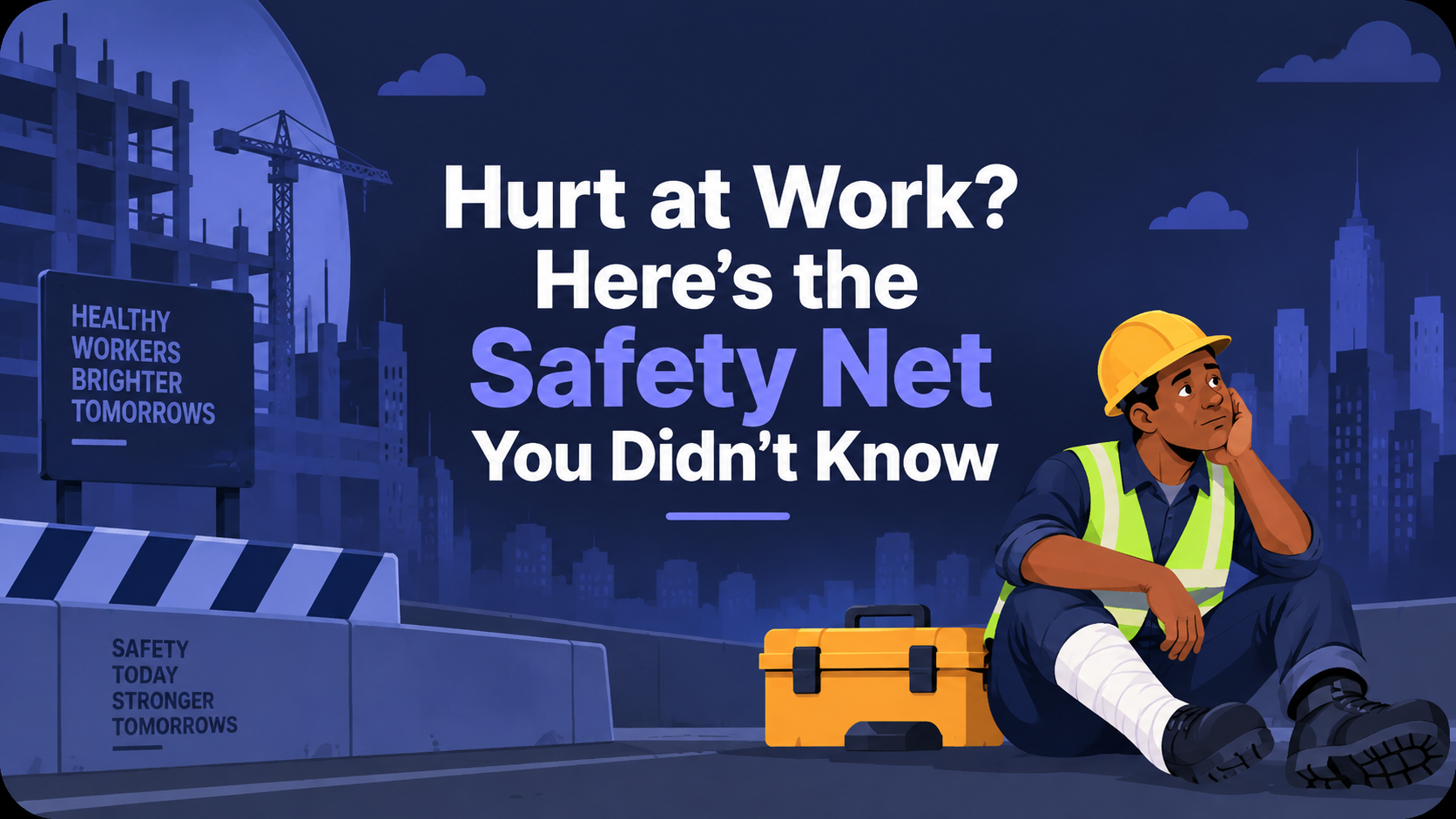
You’re at work, and you sustain an injury that keeps you off your feet for six weeks. Your manager sends a kind “get well soon” message, and HR covers one hospital bill, but after that everyone goes quiet, and you’re left at home wondering how you’ll cover the rest.
Nigerian law already has a system built for exactly this moment, and most workers have never heard of it. Let’s walk through it together.
What Is the Employees’ Compensation Scheme?
The Employees’ Compensation Act 2010 set up a fund that supports workers who get injured, fall ill, become disabled or die because of their job.
It’s run by the Nigeria Social Insurance Trust Fund (NSITF). According to NSITF, it can cover medical treatment, rehabilitation, counselling, prosthetics where needed, and compensation for temporary or permanent disability. If a worker dies from a work-related cause, their family can also be supported.
Ngozi works in a factory and develops a recognised illness linked to the chemicals she handles daily. That’s an occupational disease, and it falls under this scheme too.
Now, I know what you’re thinking. Isn’t this just pension again? No. Pension is for retirement. This scheme is for when work itself hurts you.
Who Is Covered?
Almost everyone. The Act applies to public and private sector workers across Nigeria. The main exception is members of the Armed Forces, though civilians working there are still covered. And “employee” here doesn’t only mean permanent staff with an appointment letter. It includes casual, temporary, part-time and apprentice workers, whether your contract is written or just verbal. NSITF’s guidance also confirms outsourced staff are covered.
So if someone tells you, “You’re only a casual, this doesn’t apply to you,” that’s simply not correct.
Who Pays for It? (Spoiler Alert: Not You)
Your employer must pay at least 1% of its total monthly payroll into the Employees’ Compensation Fund. Payroll here includes the staff pay used to calculate the charge, including relevant allowances, not just basic salary.
Say a small business has 20 staff, each earning ₦50,000. Its monthly payroll is ₦1 million. Its minimum contribution is ₦10,000 a month.
Your share of that? ₦0.
Let me be crystal clear: NSITF states that deducting this contribution from workers’ pay is prohibited. If you spot ₦500 labelled “NSITF” or “ECS” leaving your salary each month, that shouldn’t be happening, and it deserves a question.
And no, employers can’t opt out. In the July 2026 Pen Resource Academy case, the National Industrial Court confirmed that the 1% contribution is a legal duty with no room for discretion.
Injured at Work? Watch These Deadlines
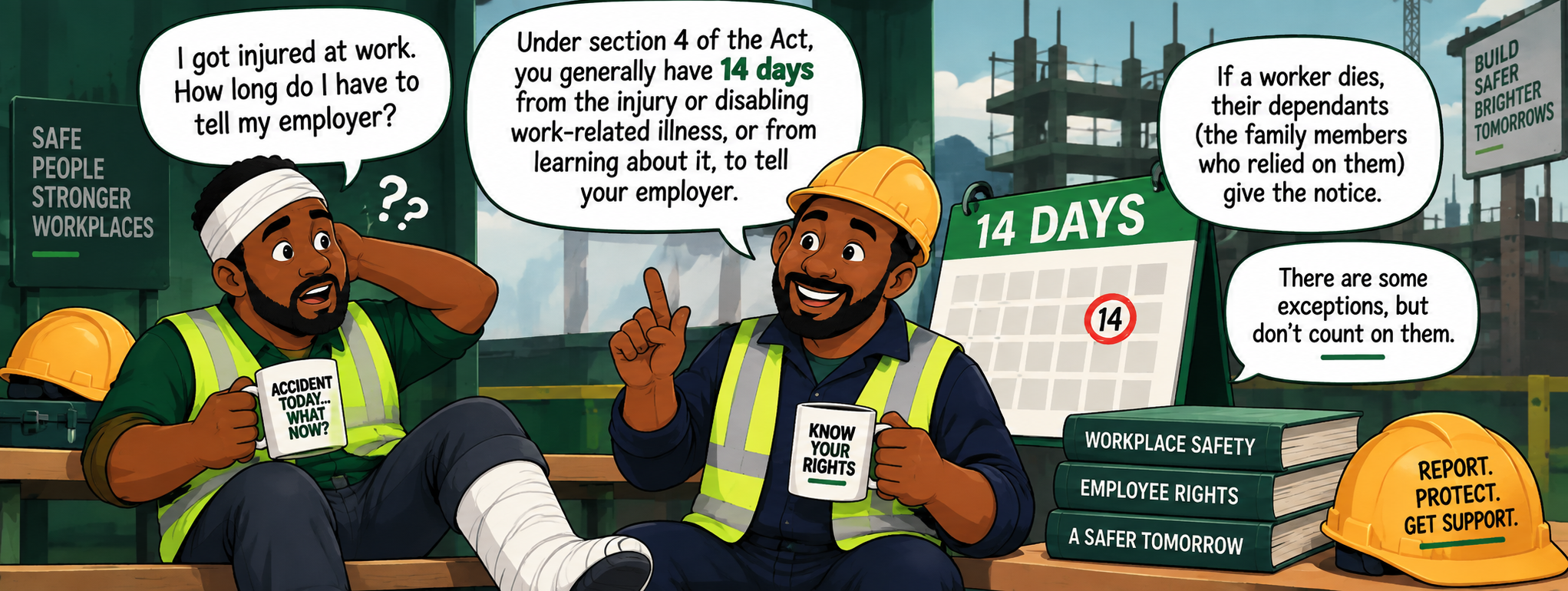
This is where many workers lose out, so pay close attention. Under section 4 of the Act, you generally have 14 days from an injury or disabling work-related illness, or from learning about it, to tell your employer. If a worker dies, their dependants, meaning the family members who relied on them, give the notice. There are some exceptions, but don’t count on them.
Under section 5, your employer must report a work-related injury to NSITF and the relevant safety office within 7 days of the injury. This is not an extra 7 days after your own 14-day period. For a disabling work-related illness, the employer has 7 days after receiving the information to report it to NSITF. A work-related death must be reported immediately.
So if your employer says, “We’ll sort out NSITF when you’re back at work,” that’s a problem. The clock is already running. Then there’s the actual compensation claim. Under section 6, you generally have one year from the injury, disability or death to file it.
Tobi was injured eight months ago and assumes it’s too late. He is still within the usual one-year claim period, although the separate reporting rules also matter. After one year, NSITF may accept a claim filed within three years of the event if special circumstances prevented an earlier application.
Report fast and in writing, and keep a copy. Your paper trail is your protection.
Does NSITF Actually Enforce This?
Yes, and 2026 has been busy. In July 2026, in NSITF v. Pen Resource Academy, the National Industrial Court held that a school had to pay the 1% contribution and keep accurate payroll records. The court also confirmed NSITF officers can enter an employer’s premises at reasonable times to inspect those records.
The court left the exact amount claimed against the school for further proceedings. The duty to contribute and provide payroll records was clear.
Schools and everyday businesses still have to follow the rules. Being “too small to notice” is not an exemption.
What You Can Do Today
You don’t need to wait for an accident to check your protection. A few simple steps go a long way.
Ask HR whether the company is registered with NSITF. Registered employers use NSITF’s Employer Self-Service Portal and can get compliance certificates, so a compliant employer should be able to answer quickly.
- Check your payslip for any NSITF or ECS deduction. There shouldn’t be one.
- Find out who handles accident reports at your workplace. If nobody knows, that’s worth raising before someone gets hurt.
- Keep any proof of your employment, like an offer letter or pay records, especially if you’re casual staff.
- And if you’re ever injured at work, report it in writing within 14 days, keep your hospital receipts, and ask for a copy of the incident report.
Why This Matters to You
Nobody plans to get hurt at work. But accidents happen in offices, warehouses, kitchens and factories every single day.
When they do, the law says you and your family shouldn’t carry the cost alone. Your employer is already required to fund that protection. You just need to know it exists, and how to use it.
So share this with a colleague or two, especially the casual staff and contract workers who’ve been told this doesn’t apply to them. They deserve to know it does.
1% of payroll with zero naira from you. Real protection when it counts.
Talk to Startpal
If you have questions about workplace protection or would like a consultation, someone on the Startpal team will be happy to talk things through. Get in touch with Startpal or email support@mystartpal.com.