
Beneficial ownership in Nigeria can become harder to track as companies grow. Shares may be held through holding companies, investment vehicles or foreign companies, and the register of members may still appear perfectly complete. But the Corporate Affairs Commission (CAC) is interested in more than the names of the companies listed as shareholders.
The important question is: who is the actual individual behind those companies who ultimately owns or controls the business?
That’s what Nigeria’s beneficial ownership rules are about. Under the Companies and Allied Matters Act 2020 (CAMA) and the Persons with Significant Control Regulations 2022, companies and limited liability partnerships (LLPs) must identify and report the real people who ultimately own or control them.
So, What Is a “Person with Significant Control”?
Here’s the thing. The law shortens it to PSC, and it simply means a real, living person (not a company) who has enough ownership or power over the business to meet the legal tests.
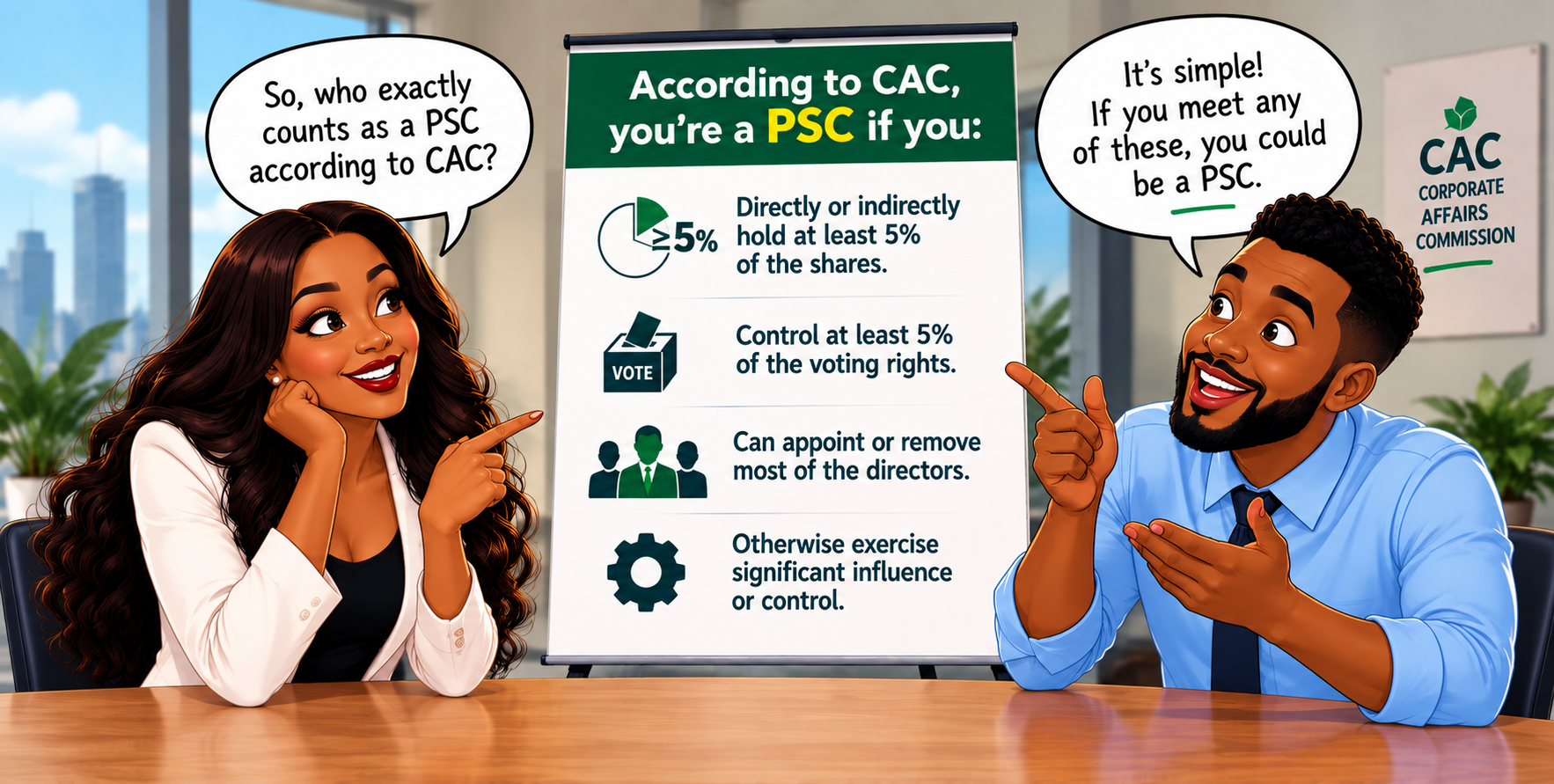
According to CAC, you’re a PSC if you directly or indirectly hold at least 5% of the shares, control at least 5% of the voting rights, can appoint or remove most of the directors, or otherwise exercise significant influence or control.
Why does the law care so much? Because companies can be used to hide money and identities. When the real owner is visible, fraud, money laundering and dodgy deals become harder to pull off.
Takeaway: Five percent, voting power, board control or real influence. Any one of these can make someone a PSC.
Trace Beneficial Ownership to a Real Person
Now, I know what you’re thinking: “Our shareholder is Global Holdings Limited. We declared it. Done.”
Unfortunately, that’s only the first link. CAC wants you to keep going until you reach the actual person at the end.
Tunde owns a holding company, and that holding company owns 30% of a Nigerian operating company. Tunde’s name never appears on the operating company’s share register, but if his indirect stake meets the PSC tests, he’s the person CAC wants to see.
The same goes for nominees, people who hold shares in their name on behalf of someone else. CAC’s 5% threshold expressly includes ownership through a nominee, so “the shares aren’t technically mine” won’t get anyone off the hook.
Control Isn’t Always About Shares
Picture a founder whose shareholding has dropped to 3%. On paper, she looks like a minor player. But the shareholders’ agreement still lets her appoint most of the board.
She may still be a PSC, because the power to appoint directors is a separate test. A spreadsheet that only checks percentages would miss her.
Who Must Report Beneficial Ownership?
The rules cover companies registered under CAMA, LLPs, and foreign companies granted exemption to operate in Nigeria. If you run a business name (a sole proprietorship or ordinary partnership), this particular regime doesn’t apply to you in the same way.
Beneficial Ownership Reporting Deadlines
Let me be crystal clear about the deadlines, because there are two.
Under section 119 of CAMA, a person who becomes a PSC must tell the company within seven days. The company then has one month to notify CAC, and must also disclose the PSC information in its annual return. LLPs follow a similar framework under section 791.
Amaka owns 4% of a company. A fellow shareholder transfers some shares to her, and she rises to 7%. She’s crossed the 5% line, so she must inform the company within seven days, and the company must then update CAC. If she later sells down to 2%, that change needs reporting too.
What Happens If You Ignore This?
This is where it gets expensive. If a company fails to identify or disclose its PSCs, the Regulations impose daily penalties: ₦10,000 for a small company, ₦20,000 for other companies and companies limited by guarantee, ₦25,000 for a public company, and ₦10,000 for an LLP.
Read that word again: daily. A forgotten filing left for a month could cost a small company ₦300,000.
And if you’ve given your bank different PSC details from what CAC holds, a separate penalty of ₦50,000 to ₦200,000 can apply, depending on the type of entity. Here’s what really hurts. CAC won’t approve your annual return or issue a Letter of Good Standing until your PSC information is in order. It can even mark a non-compliant company as inactive in some cases. Imagine landing a big contract, and the client asks for your Letter of Good Standing by Friday. That’s a terrible week to start figuring out who owns your company.
Anyone Can Look You Up
CAC runs a public Beneficial Ownership Register. Anyone can search it by company name, RC number or PSC name and see details like the PSC’s name, nationality, occupation and the nature of their control.
That means investors, lenders and business partners can check your ownership story before they trust your pitch deck.
Why This Matters to You
Beneficial ownership sounds like a problem for giant multinationals, but it creeps up on ordinary businesses too: a founder gifts shares to a relative, an investor joins, a holding company is added, and suddenly the real controller isn’t obvious.
So set aside some time this week. Trace every ownership route to a real person, check them against the PSC tests, and compare your internal register, your latest CAC filing and the public register. If they tell different stories, find out why and fix it.
Keeping beneficial ownership records up to date is easier than trying to fix them when a bank or potential investor is waiting. Make ownership checks part of every share transfer, new investment and change in control.
These records also contain personal information. Read our guide to Nigeria’s data protection rules for businesses for more on handling that information responsibly.
Need help with your company records?
If you have questions about beneficial ownership or need a consultation, someone at Startpal will be happy to talk with you. Contact Startpal or email support@mystartpal.com to discuss your company records and the next steps.