On 23 September 2026, Nigeria’s Securities and Exchange Commission (SEC) issued a circular. It directs all public companies, and certain major capital market operators, to submit a plan showing how they will adopt the IFRS Sustainability Disclosure Standards.
The deadline is 15 October 2026. Let me be crystal clear about one thing. SEC is asking for a plan by that date. A full sustainability report comes later.
What do IFRS S1 and S2 mean?
Now, I know what you’re thinking. “Those names sound like a robot’s password.”
They’re simpler than they look. IFRS S1 asks companies to tell investors about sustainability risks and opportunities that could affect their money. Think cash flow, access to loans and the cost of borrowing.
IFRS S2 zooms in on climate. That covers things like flooding and extreme weather, plus the risks that come as the world moves toward lower-carbon energy.
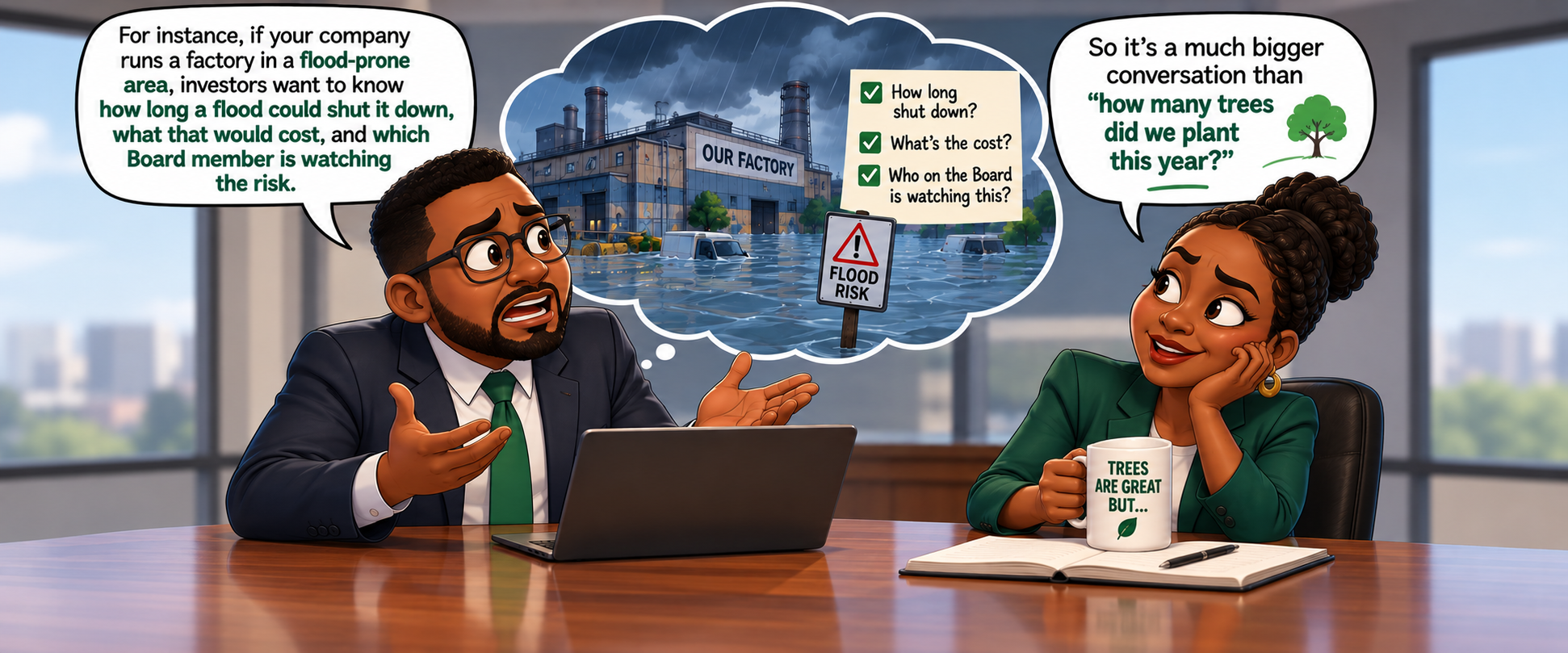
For instance, if your company runs a factory in a flood-prone area. Investors want to know how long a flood could shut it down, what that would cost, and which Board member is watching the risk. That’s a much bigger conversation than “how many trees did we plant this year?”
Who must submit an implementation plan?
This deadline applies to two groups:
- Public companies
- Significant Public Interest Capital Market Operators, meaning organisations such as exchanges, clearing houses and central securities depositories
A small private business is not automatically covered by this SEC filing deadline. Its reporting duties depend on where it falls under Nigeria’s adoption roadmap.
What should an IFRS S1 and S2 plan include?
SEC listed eight minimum items. Here they are in plain English:
- Governance: Who owns this, and how does the Board oversee it?
- Gap assessment: Where is the company today compared with what the standards ask for?
- Roadmap and timeline: Real dates. “We’ll comply eventually” won’t cut it.
- Data systems: Where will the numbers come from?
- Internal controls and assurance: Who checks the numbers?
- Staff training: Who actually understands all this?
- First reporting year: When will the company start?
- Expected challenges: What could go wrong?
That last one is my favourite. SEC wants honesty. A plan that says “no challenges, everything is excellent” won’t convince anybody.
What could change for employees?
Sustainability numbers don’t appear from thin air. Someone has to record them.
Lets take Ngozi’s case for instance who is an admin officer earning ₦150,000 a month. One day she’s asked to log the office generator’s diesel purchases every week. That log might feed into a climate figure in a report investors will read.
Suddenly her spreadsheet matters. Now, let me be honest about a limit. The circular says nothing about extra pay for extra tasks. It sets reporting requirements for companies, rather than rules about employee pay.
If your responsibilities change a lot, it is worth discussing your role, workload and training needs with your manager.
Does mandatory reporting start in 2028?
Yes, for public interest entities. Under Nigeria’s adoption roadmap, public interest entities, including public companies, must report for accounting periods beginning on or after 1 January 2028. SMEs follow for accounting periods beginning on or after 1 January 2030.
Before then, voluntary adoption is welcome. So why the rush? Because 2026 is the preparation phase. SEC wants proof that companies are really getting ready. 2028 sounds far away, but preparation starts today.
The biggest mistake companies can make
Waiting. It sounds sensible: “We’ll sort it out in 2027.” But think about what’s involved.
Data needs systems. Systems need controls. Controls need testing. People need training. The Board needs a governance structure. Some information may even need historical records that nobody kept.
If your finance team has tracked revenue for decades. Your energy consumption records sit in three departments, in four different formats. Rebuilding all that in a panic won’t be fun.
How to start preparing
If your company is affected, here’s a simple starting point:
- Find out who owns the SEC submission.
- Ask whether Finance, Risk, Legal, Internal Audit and IT are talking to each other.
- Check whether the Board knows about the deadline.
If your company is outside this circular, check where it falls on the roadmap. The timetable depends on the type of business.
Why this matters beyond the deadline?
Let me bring it home. Clear reporting can help investors understand a company’s risks and plans. That can support funding decisions, although good reports alone do not guarantee investment.
Understanding sustainability reporting can also be a useful skill at work. Being able to explain IFRS S1 and S2 in plain language is a good place to start.
And if you’re ever the one asked, “Who’s handling our plan?”, you’ll know exactly what to say.
If this made things clearer, send it to a colleague. Forward it to the person in your team who always knows what’s happening. Then ask one simple question at work: “Who owns our sustainability plan?”
You don’t need to be a lawyer or an accountant to ask it. Knowledge makes you stronger at work, so keep learning and keep asking.
More on business compliance
For another example of business reporting duties, read why customer data is a legal responsibility. Find more updates in Regulatory News.
Need help with your next steps?
If you have questions about what this means for your business or would like to book a consultation, someone at Startpal is happy to talk. Get in touch with Startpal or email support@mystartpal.com to discuss the next steps.