

So you’ve just landed a remote consulting gig with a UK firm. The pay is in pounds, the company is registered in London, and you do every single bit of your work from your kitchen table in Abuja. You feel like you’ve cracked the code. No Nigerian employer, no Nigerian payroll, surely FIRS isn’t coming for that money, right?
Sit down. We need to have a conversation!
The Nigeria Tax Act, 2025 is very clear on this point, and what it says might genuinely surprise you, or frustrate you, depending on your mood today.
Your Address Is Your Tax Starting Point
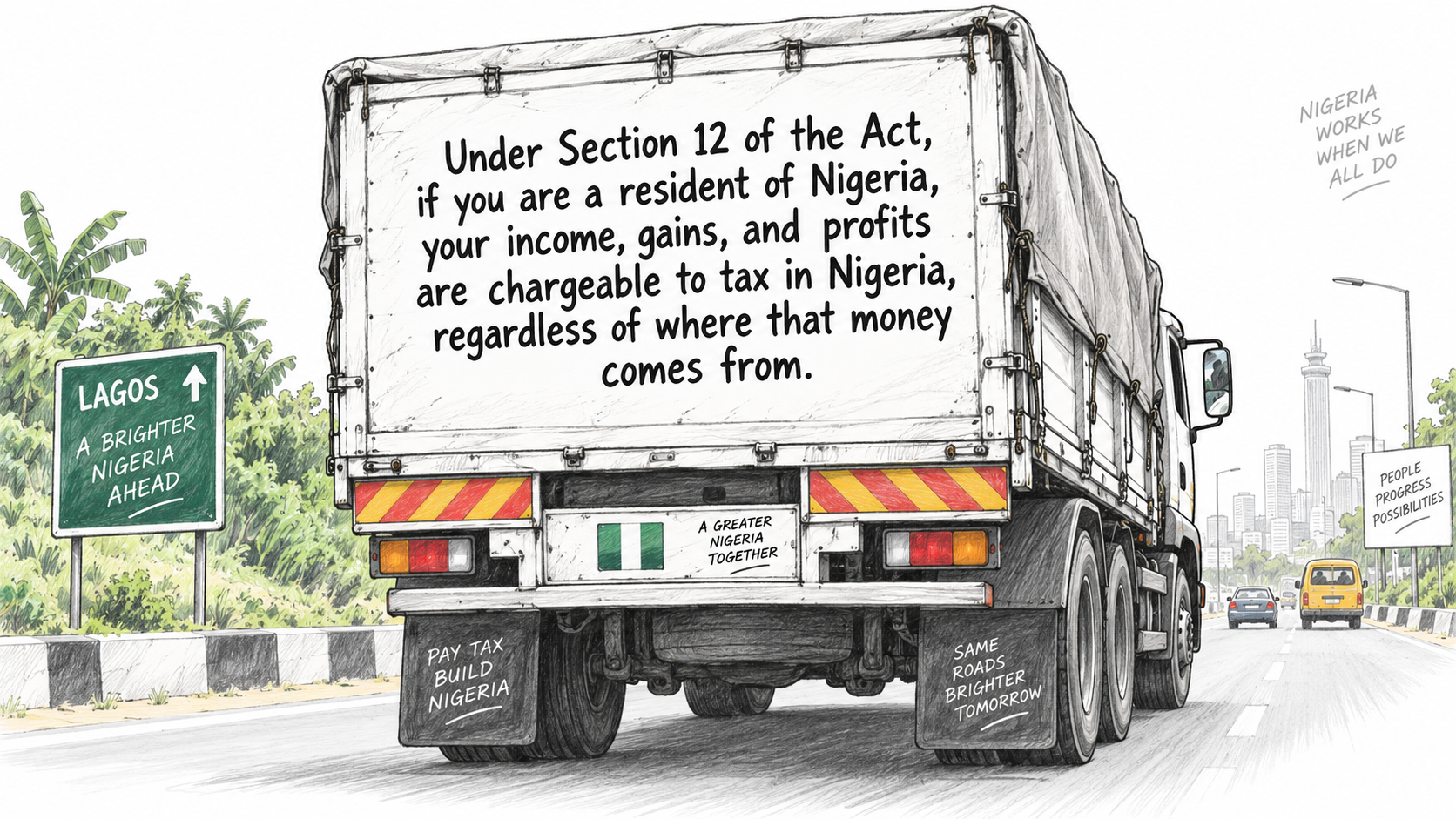
Under Section 12 of the Act, if you are a resident of Nigeria, your income, gains, and profits are chargeable to tax in Nigeria, regardless of where that money comes from. Your client could be in Tokyo, Toronto, or Timbuktu. It genuinely does not matter.
Here’s the thing. The Act specifically states that income is taxable “whether or not the income, profits or gains have been brought into or received in Nigeria.” Let me be crystal clear about what this means. FIRS is not waiting for your dollar transfer to land in your GTBank account before it counts. The moment you earn that income, the tax obligation exists. Your money does not have to cross Nigerian soil for Nigeria to have a legal claim on it.
This is called a residence based tax principle, and it is the bedrock of how Nigeria taxes individuals under this legislation. For a broader overview of what this Act covers, see our earlier explainer on the Nigeria Tax Act 2025.
Who Exactly Is a “Resident”?
If Nigeria is where you live and where your daily life happens, Nigeria considers you a tax resident. If you’re a professional based in Lagos, Abuja, Ibadan, Port Harcourt, or anywhere else in the country, even with entirely foreign clients, you are almost certainly a Nigerian tax resident by default. Your laptop may operate seamlessly across time zones, but your tax obligations do not travel with it.
What About Formal Employment?
Section 13 goes even further, and this is where things get particularly relevant for people in structured jobs or payroll arrangements with foreign employers.
Your employment income is deemed to be derived from Nigeria in two specific situations. The first is straightforward. If you are a resident of Nigeria, the obligation flows automatically from that fact alone. The second situation is worth reading carefully. Even if you are not a permanent, full time Nigerian resident, if the duties of your employment are wholly or partly performed in Nigeria, the income you earn while doing that work here is taxable in Nigeria, unless it is already being properly taxed in your country of tax residence.
Now, I know what you’re thinking. “Partly performed in Nigeria” sounds like it could cast a very wide net, and you are absolutely correct. If you work for a foreign company but spend three months of the year working from Lagos while visiting family, the income you earned during those three months sits squarely within Nigeria’s tax reach.
Take Adaeze, for Example
She is a UX researcher in Lagos who works remotely for a German tech company. Her salary, around ₦7.2 million a year, hits a Revolut account every month. She’s convinced herself that because the company is German, the income sits outside FIRS’s reach.
She’s wrong. Section 12 of the Nigeria Tax Act, 2025 says otherwise. Because Adaeze lives in Nigeria, that German salary is Nigerian taxable income. She has to declare it on her annual personal income tax return and pay at the applicable rate, the same way she would if a Lagos company signed her cheques.
Most Nigerians in her position are not filing. That’s the honest truth. But it doesn’t change the law, and the Act is very clear about it.
What If You Own a Business?
If you run a business or hold shares in a Nigerian company, Section 6 speaks to you with equal clarity. The profits of a Nigerian company are deemed to accrue in Nigeria wherever they arise. Contracts executed in Ghana, consultancy fees paid from the UK, digital services sold across the continent, all of it qualifies as Nigerian profit for tax purposes. The moment your business is incorporated in Nigeria, its global revenue is within scope.
Why Is the Law This Broad?
Nigeria’s tax framework is deliberately wide, and understanding the reasoning behind that helps you take it seriously. Tax revenue funds public infrastructure: roads, healthcare, education, government services. The legislators who drafted this Act designed it to ensure that Nigerians who earn globally still contribute meaningfully to the national revenue base. Your feelings about how efficiently that revenue gets spent are entirely valid and a separate conversation, but the legal obligation to declare and pay exists completely independently of that debate.
An intentionally broad law is not one you can comfortably ignore. Ignoring it is not a strategy. It’s a liability that compounds every year you leave it unaddressed.
So What Should You Actually Do?
If you earn income from foreign sources while living in Nigeria, you have a filing obligation. You need to declare that income when you complete your annual personal income tax return. The fact that no employer is deducting PAYE does not make the obligation disappear. It shifts the responsibility directly onto you to self assess, calculate, and pay. This is called direct assessment, and it applies to self employed individuals and those with foreign income streams.
If you are uncertain how your foreign income should be treated, especially in situations where the same money might technically be taxable in two countries, Nigeria maintains double taxation agreements with a number of countries that can limit your exposure. A qualified tax consultant can help you understand exactly where you stand and structure your affairs properly.
What Is The Bigger Picture?
The Nigeria Tax Act, 2025 is not ambiguous, and it is not going anywhere. Whether you earn your income from a Lagos office, a remote contract, a digital product sold online, or a foreign employer, this law sees your income and treats it as taxable. The only variable is whether you are positioned to meet that obligation properly, with your records in order, rather than being caught off guard when an assessment arrives.
If you know someone working remotely and assuming that “foreign income” equals “tax free income,” share this with them. That assumption is expensive, and now they have no excuse for not knowing better.
Feeling overwhelmed?
We know the terminology can feel dense, and it’s easy to read something like this and still not be sure where your own situation lands. If you’d like to talk it through, someone on our team would be genuinely happy to sit with you. Book a consultation and we’ll go through your specific circumstances, what applies to you, and what your next step looks like. [Schedule a consultation →]